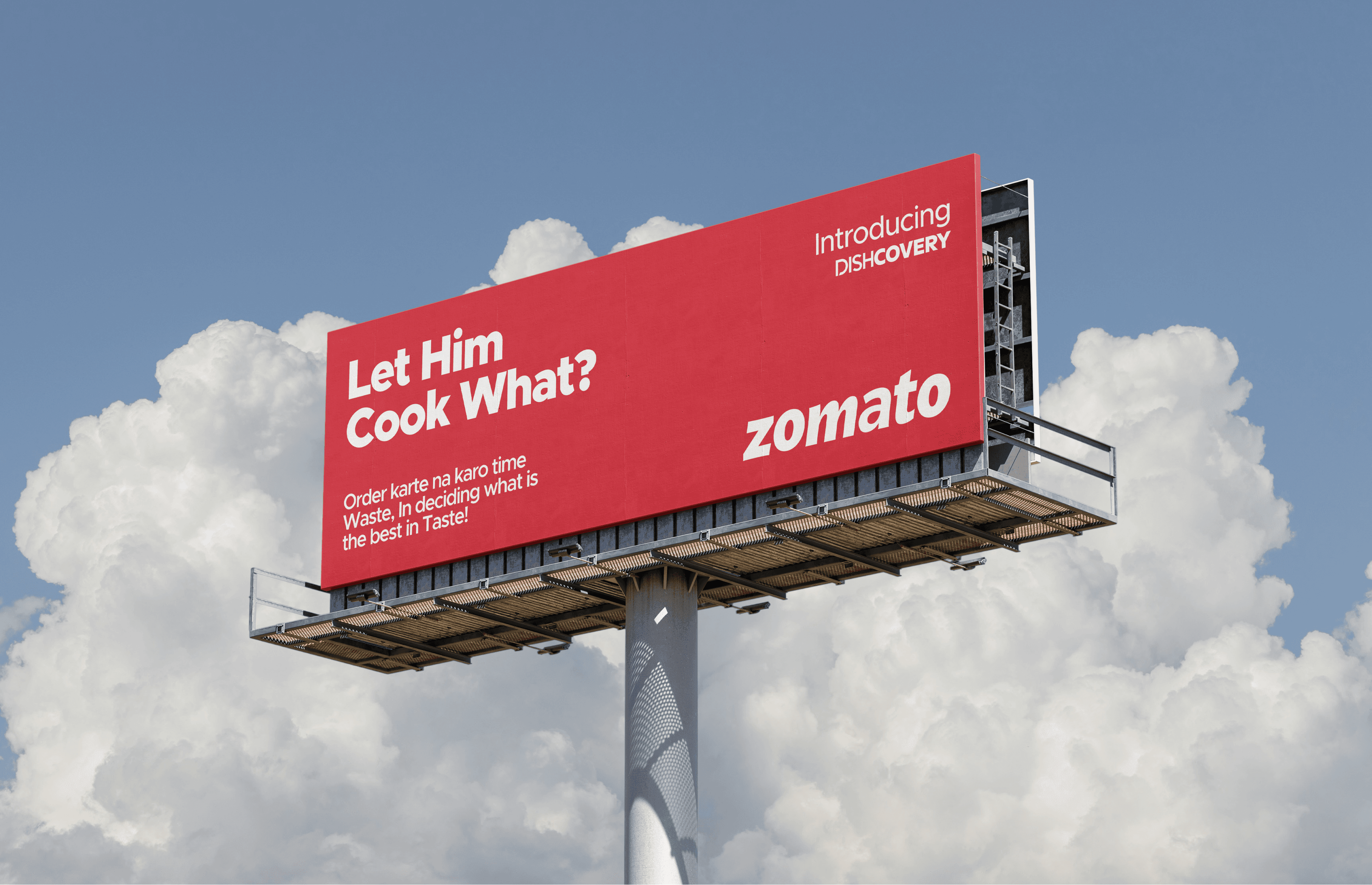
Zomato Dishcovery.

Zomato Dishcovery.

Zomato Dishcovery.

UI/UX DESIGN

UI/UX DESIGN

UI/UX DESIGN

Zomato Swipe is a self-initiated service design project exploring a new way to reduce decision fatigue in food ordering. The concept introduces a swipe-based interaction that lets users browse and choose dishes directly, rather than scrolling through restaurants and cuisines. Designed to feel native to Zomato’s existing design system, the feature blends familiarity with delight, helping users decide faster while making the discovery process more engaging.

Zomato Swipe is a self-initiated service design project exploring a new way to reduce decision fatigue in food ordering. The concept introduces a swipe-based interaction that lets users browse and choose dishes directly, rather than scrolling through restaurants and cuisines. Designed to feel native to Zomato’s existing design system, the feature blends familiarity with delight, helping users decide faster while making the discovery process more engaging.

Zomato Swipe is a self-initiated service design project exploring a new way to reduce decision fatigue in food ordering. The concept introduces a swipe-based interaction that lets users browse and choose dishes directly, rather than scrolling through restaurants and cuisines. Designed to feel native to Zomato’s existing design system, the feature blends familiarity with delight, helping users decide faster while making the discovery process more engaging.

Timeline

Timeline

Timeline

2 Weeks

2 Weeks

2 Weeks

Discipline

Discipline

Discipline

UI/UX Designer

UI/UX Designer

UI/UX Designer

Tools

Tools

Tools

Figma, Notion

Figma, Notion

Figma, Notion

Context & Challenge.

Context & Challenge.

Context & Challenge.

Many users who order food online frequently struggle with decision fatigue and indecisiveness when choosing what to eat. They often default to familiar options, missing out on discovering new and exciting dishes in their city. This limits their culinary exploration and reduces engagement with the platform.

Many users who order food online frequently struggle with decision fatigue and indecisiveness when choosing what to eat. They often default to familiar options, missing out on discovering new and exciting dishes in their city. This limits their culinary exploration and reduces engagement with the platform.

Opportunity.

Opportunity.

Opportunity.

How might we design an intuitive and engaging exploration feature that helps users effortlessly discover new dishes based on their location, preferences, and ordering habits while making the decision process more exciting?

How might we design an intuitive and engaging exploration feature that helps users effortlessly discover new dishes based on their location, preferences, and ordering habits while making the decision process more exciting?

The Problem.

The Problem.

1

Dont Know What to Order

2

Overwhelming number of choices.

3

Lack of discovery.

1

Dont Know What to Order

2

Overwhelming number of choices.

3

Lack of discovery.

1

Dont Know What to Order

2

Overwhelming number of choices.

3

Lack of discovery.

RESEARCH

RESEARCH

Primary Research.

Primary Research.

I conducted three informal interviews with frequent Zomato users. All participants identified themselves as food enthusiasts and used the platform regularly.

I conducted three informal interviews with frequent Zomato users. All participants identified themselves as food enthusiasts and used the platform regularly.

User Personas

User Personas

A consistent pattern emerged across all conversations. While users appreciated the sheer variety Zomato offers, they also felt overwhelmed by it. Participants described the ordering process as mentally taxing, especially during the initial phase where they are required to choose between cuisines, restaurants, and dishes all at once.

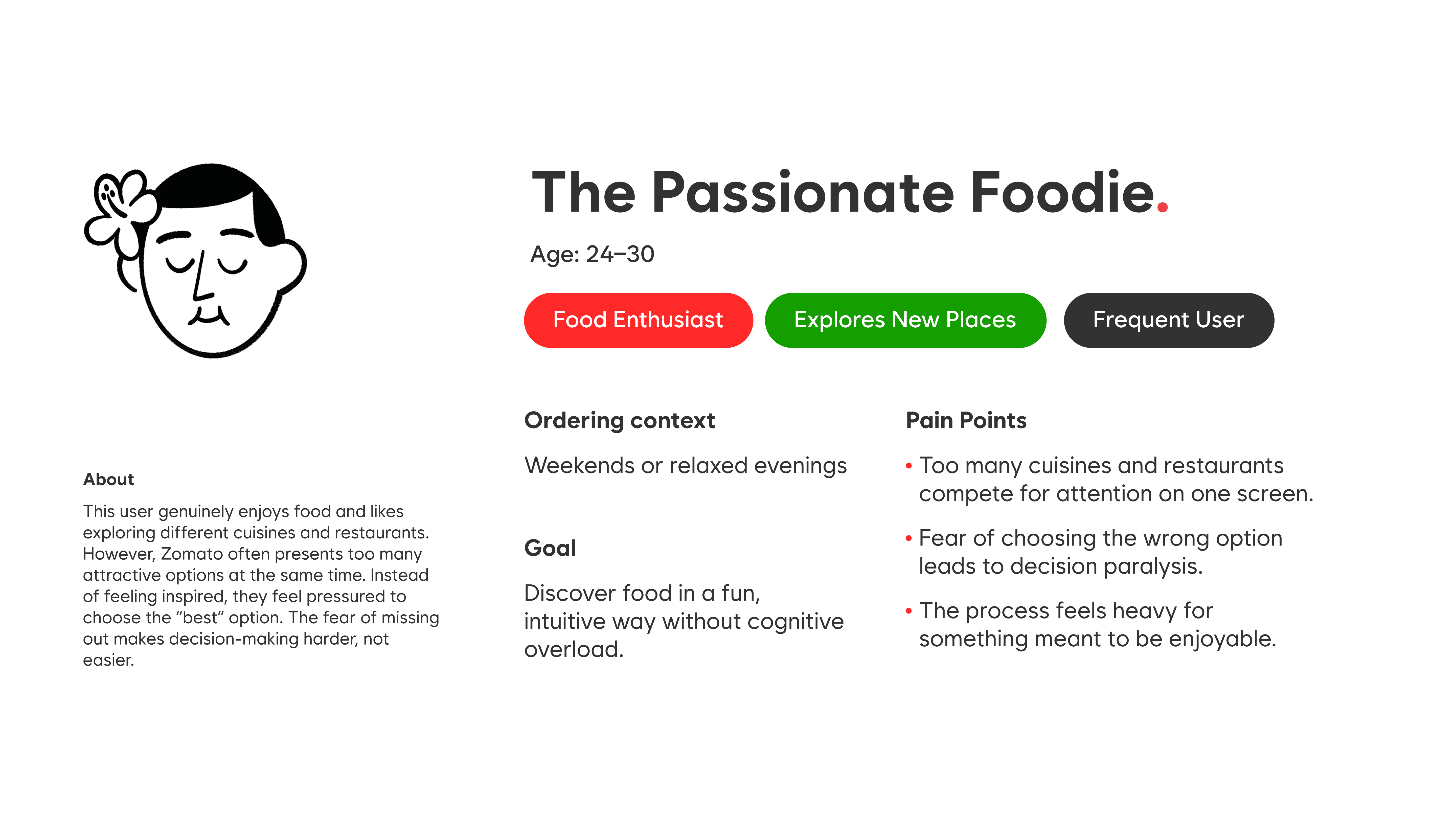
A consistent pattern emerged across all conversations. While users appreciated the sheer variety Zomato offers, they also felt overwhelmed by it. Participants described the ordering process as mentally taxing, especially during the initial phase where they are required to choose between cuisines, restaurants, and dishes all at once.
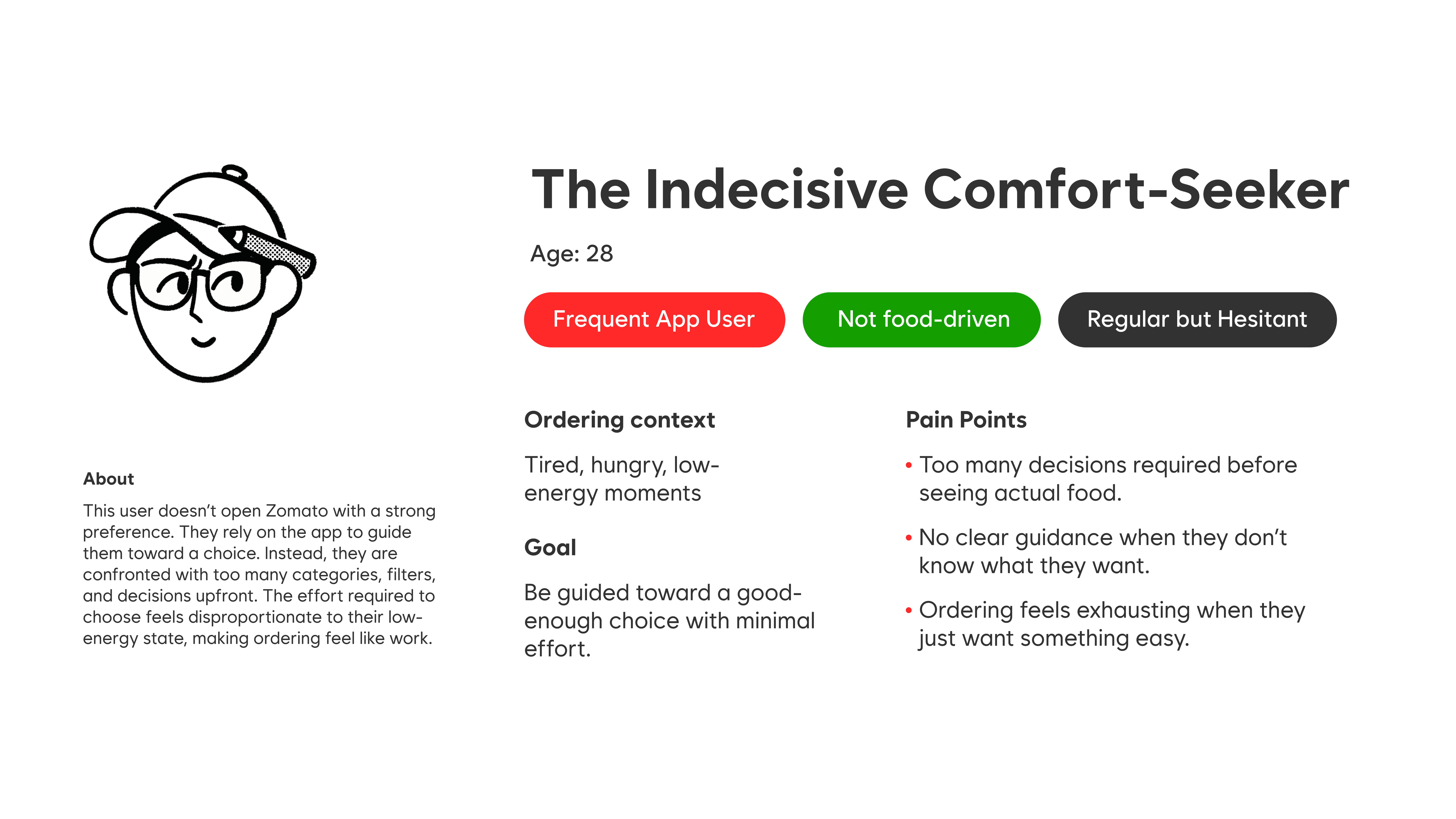
  • Card image
  • Card image
  • Card image
  • Card image
  • Card image
  • Card image
  • Card image
  • Card image
  • Card image

Users shared that the abundance of options often turns a simple craving into a prolonged decision loop. Scrolling through multiple screens, comparing menus, and second-guessing choices frequently stretched the process to nearly an hour. By the time they reached the ordering stage, the excitement or craving for food had significantly reduced.

Users shared that the abundance of options often turns a simple craving into a prolonged decision loop. Scrolling through multiple screens, comparing menus, and second-guessing choices frequently stretched the process to nearly an hour. By the time they reached the ordering stage, the excitement or craving for food had significantly reduced.

This problem felt more intense for users who identified as indecisive. Instead of helping them decide, the interface amplified uncertainty by presenting too many choices simultaneously, without guiding or narrowing the decision early on.

This problem felt more intense for users who identified as indecisive. Instead of helping them decide, the interface amplified uncertainty by presenting too many choices simultaneously, without guiding or narrowing the decision early on.

RESEARCH

RESEARCH

Secondary Research.

Secondary Research.

To support interview insights, I reviewed existing articles and UX discussions around choice overload and decision fatigue in digital products.

To support interview insights, I reviewed existing articles and UX discussions around choice overload and decision fatigue in digital products.

To support interview insights, I reviewed existing articles and UX discussions around choice overload and decision fatigue in digital products.

Research around choice overload suggests that while users enjoy having options, too many choices presented at once can reduce satisfaction and slow down decision-making. Food delivery apps are particularly vulnerable to this because decisions are emotional, time-sensitive, and often made when users are already tired or hungry.

Research around choice overload suggests that while users enjoy having options, too many choices presented at once can reduce satisfaction and slow down decision-making. Food delivery apps are particularly vulnerable to this because decisions are emotional, time-sensitive, and often made when users are already tired or hungry.

Research around choice overload suggests that while users enjoy having options, too many choices presented at once can reduce satisfaction and slow down decision-making. Food delivery apps are particularly vulnerable to this because decisions are emotional, time-sensitive, and often made when users are already tired or hungry.

9:41

32

9:41

32

9:41

32

RESEARCH

RESEARCH

Tertiary Research.

Tertiary Research.

I looked at how people make decisions in non-food contexts such as dating apps, short-form content platforms, and streaming services.

I looked at how people make decisions in non-food contexts such as dating apps, short-form content platforms, and streaming services.

These platforms reduce decision pressure by allowing users to react instinctively through simple gestures like swiping, liking, or skipping. The emphasis is on momentum rather than commitment. Users are not forced to decide immediately; instead, they move forward by eliminating what they don’t want.

These platforms reduce decision pressure by allowing users to react instinctively through simple gestures like swiping, liking, or skipping. The emphasis is on momentum rather than commitment. Users are not forced to decide immediately; instead, they move forward by eliminating what they don’t want.

This behavioral pattern suggested an opportunity to rethink food selection not as a search problem, but as a discovery and elimination process driven by instinct.

This behavioral pattern suggested an opportunity to rethink food selection not as a search problem, but as a discovery and elimination process driven by instinct.

Key Research Insights.

Key Research Insights.

RESEARCH

RESEARCH

Indecisive users want direction, not control.

How Might We?

How might we guide indecisive users toward a satisfying choice without making them feel restricted?

How might we guide indecisive users toward a satisfying choice without making them feel restricted?

Indecisive users want direction, not control.

How Might We?

How might we guide indecisive users toward a satisfying choice without making them feel restricted?

Users prefer eliminating options over selecting one.

How Might We?

How might we help users decide what to eat without forcing them to think too much, too early?

How might we help users decide what to eat without forcing them to think too much, too early?

Users prefer eliminating options over selecting one.

How Might We?

How might we help users decide what to eat without forcing them to think too much, too early?

Too many good options feel worse than a few great ones.

How Might We?

How might we satisfy the user’s food craving by reducing the time from opening the app to ordering?

How might we satisfy the user’s food craving by reducing the time from opening the app to ordering?

Too many good options feel worse than a few great ones.

How Might We?

How might we satisfy the user’s food craving by reducing the time from opening the app to ordering?

DESIGN PROCESS

DESIGN PROCESS

Design Principles.

Design Principles.

Reduce upfront decisions

The experience should avoid asking users to choose cuisines, restaurants, or filters at the start. Decisions should unfold gradually, not all at once.
Make elimination easier than selection

Users should be able to reject options quickly without feeling the pressure to commit to a final choice.

Guide without restricting

The system should subtly steer users toward good options while still allowing flexibility and exploration.

DESIGN PROCESS

DESIGN PROCESS

Concept Overview.

Concept Overview.

Zomato Swipe reimagines food ordering as a fast, instinctive discovery experience rather than a search-heavy decision process.

Zomato Swipe reimagines food ordering as a fast, instinctive discovery experience rather than a search-heavy decision process.

Instead of asking users to choose cuisines, restaurants, and filters upfront, the concept shifts the focus to individual dishes. Users are presented with one option at a time and interact using simple swipe gestures to either skip or show interest. This reduces cognitive load and allows users to react based on craving rather than comparison.

Instead of asking users to choose cuisines, restaurants, and filters upfront, the concept shifts the focus to individual dishes. Users are presented with one option at a time and interact using simple swipe gestures to either skip or show interest. This reduces cognitive load and allows users to react based on craving rather than comparison.

Zomato Swipe transforms indecision into motion. By turning food selection into a lightweight, playful interaction, it helps users reach a decision faster while preserving the excitement of ordering.

Zomato Swipe transforms indecision into motion. By turning food selection into a lightweight, playful interaction, it helps users reach a decision faster while preserving the excitement of ordering.

DESIGN PROCESS

DESIGN PROCESS

User Flow.

User Flow.

The Zomato Swipe experience is designed to minimize friction and maintain momentum from the moment the user enters the feature.

The Zomato Swipe experience is designed to minimize friction and maintain momentum from the moment the user enters the feature.

The user starts by selecting Swipe Mode from the home screen. This acts as an alternative entry point for users who want help deciding rather than browsing.

The user starts by selecting Swipe Mode from the home screen. This acts as an alternative entry point for users who want help deciding rather than browsing.

DESIGN PROCESS

DESIGN PROCESS

Wireframe Overview.

Wireframe Overview.

Designing wireframes was the final part of the project, In the process I made a lot of changes to the sketched out wireframes. Fortunately the sketches were quite accurate and made it to the actual wireframes of the application.

Designing wireframes was the final part of the project, In the process I made a lot of changes to the sketched out wireframes. Fortunately the sketches were quite accurate and made it to the actual wireframes of the application.

The Swipe Mode entry is placed on the home screen as an optional pathway. It does not replace traditional browsing, but clearly signals an alternative for users who feel unsure about what to order.

The Swipe Mode entry is placed on the home screen as an optional pathway. It does not replace traditional browsing, but clearly signals an alternative for users who feel unsure about what to order.

First Screen

First Screen

This was the first landing screen for Dishcovery that the users will interact with when they click on the new explore feature (from zomato homepage).

This was the first landing screen for Dishcovery that the users will interact with when they click on the new explore feature (from zomato homepage).

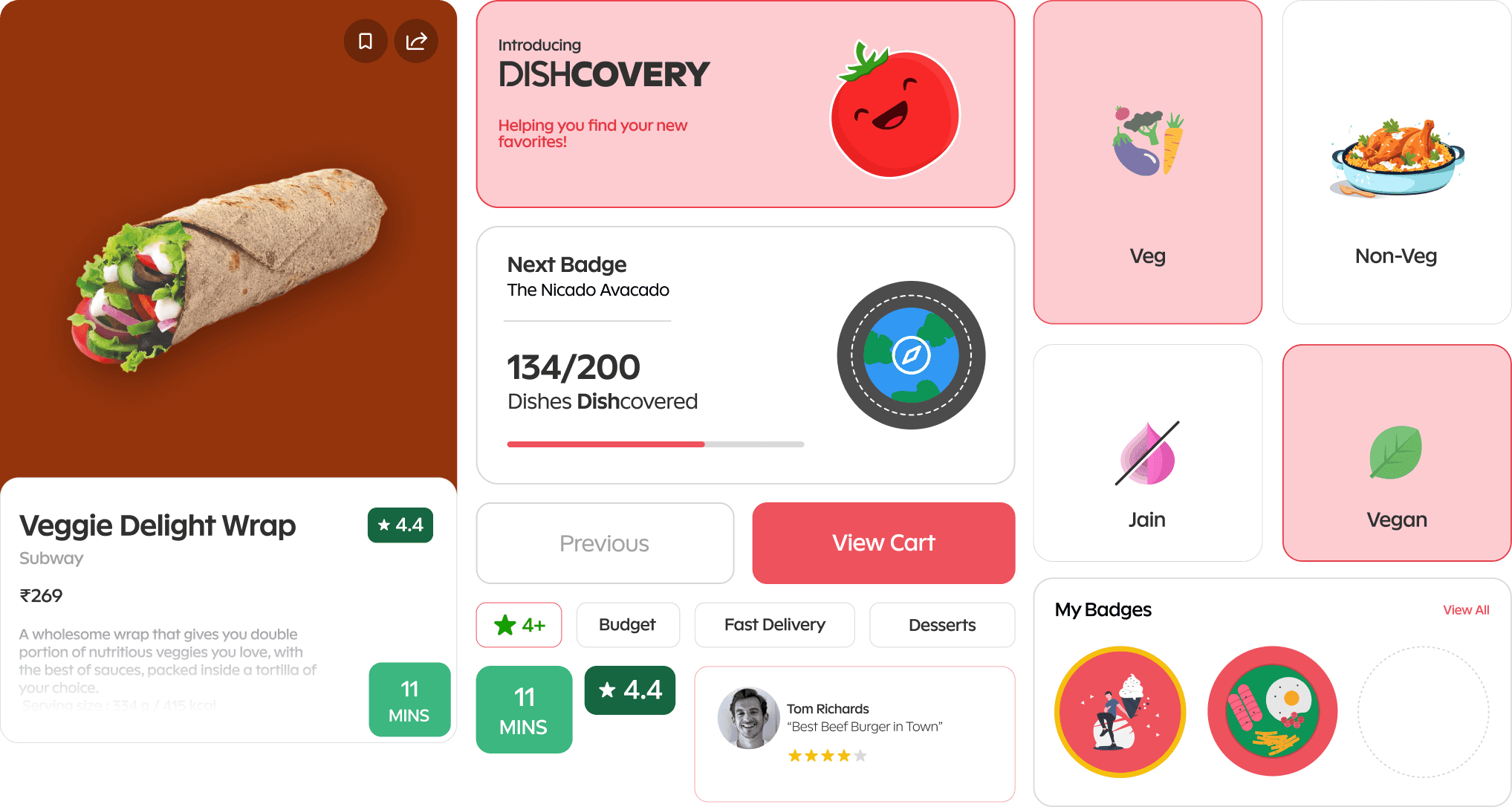
This screen is the first step towards a personalized experience. It initially consisted 3 filters Veg, Non-Veg, and Jain. As the goal was to find new favourite dishes for the customers in the least amount of time, this helps speed up the process more!

This screen is the first step towards a personalized experience. It initially consisted 3 filters Veg, Non-Veg, and Jain. As the goal was to find new favourite dishes for the customers in the least amount of time, this helps speed up the process more!

Swipe Screen

Swipe Screen

This Screen was the most important screen for Dishcovery. As we all love using our thumbs so much for scrolling, why not you it for exploring food too!


This screen consists of all the ‘Masala’ for the feature. You’re welcomed with a dish ready to be served. All the information regarding the dish will be displayed on this screen.

We added additional filtering to help you pin point your dish even more!

This Screen was the most important screen for Dishcovery. As we all love using our thumbs so much for scrolling, why not you it for exploring food too!


This screen consists of all the ‘Masala’ for the feature. You’re welcomed with a dish ready to be served. All the information regarding the dish will be displayed on this screen.

We added additional filtering to help you pin point your dish even more!

DESIGN PROCESS

DESIGN PROCESS

Visual Design.

Visual Design.

The visual design of Zomato Swipe intentionally stays consistent with Zomato’s existing design system. Instead of introducing a new visual style, the concept adapts the current visual language to a new interaction pattern.

The visual design of Zomato Swipe intentionally stays consistent with Zomato’s existing design system. Instead of introducing a new visual style, the concept adapts the current visual language to a new interaction pattern.

By retaining familiar colors, typography, iconography, and component styles, the experience feels immediately recognizable and trustworthy. This reduces the learning curve and ensures that the new feature integrates seamlessly into the existing app ecosystem.

By retaining familiar colors, typography, iconography, and component styles, the experience feels immediately recognizable and trustworthy. This reduces the learning curve and ensures that the new feature integrates seamlessly into the existing app ecosystem.

Colors.

Colors.

By adapting Zomato’s current visual language, the focus remains on improving decision-making through interaction, not visual reinvention. The familiarity of the interface allows users to immediately engage with the feature without friction.

By adapting Zomato’s current visual language, the focus remains on improving decision-making through interaction, not visual reinvention. The familiarity of the interface allows users to immediately engage with the feature without friction.

01

Zomato Red

02

Forest Green

03

Charcoal Black

01

Zomato Red

01

Zomato Red

02

Forest Green

03

Charcoal Black

01

Zomato Red

01

Zomato Red

02

Forest Green

03

Charcoal Black

01

Zomato Red

Icons.

Icons.

I kept the iconography closely aligned with Zomato’s existing icons to maintain visual consistency and ensure the meaning of each action is instantly clear to users.

I kept the iconography closely aligned with Zomato’s existing icons to maintain visual consistency and ensure the meaning of each action is instantly clear to users.

DESIGN PROCESS

DESIGN PROCESS

Design Components.

Design Components.

The Design components are created keeping in mind that the visual language of zomato has to follow this. I have kept it very clean and very similar to what it is.

The Design components are created keeping in mind that the visual language of zomato has to follow this. I have kept it very clean and very similar to what it is.

OUTCOME

OUTCOME

Key Features.

Key Features.

The key features are designed to reduce decision fatigue by simplifying how choices are presented and guiding users toward faster, more instinctive food decisions, while remaining consistent with Zomato’s existing experience. Subtle gamified cues, turning food discovery into an interactive experience that feels rewarding rather than overwhelming.

The key features are designed to reduce decision fatigue by simplifying how choices are presented and guiding users toward faster, more instinctive food decisions, while remaining consistent with Zomato’s existing experience. Subtle gamified cues, turning food discovery into an interactive experience that feels rewarding rather than overwhelming.

Quick Dietary Preference Setup

Quick Dietary Preference Setup

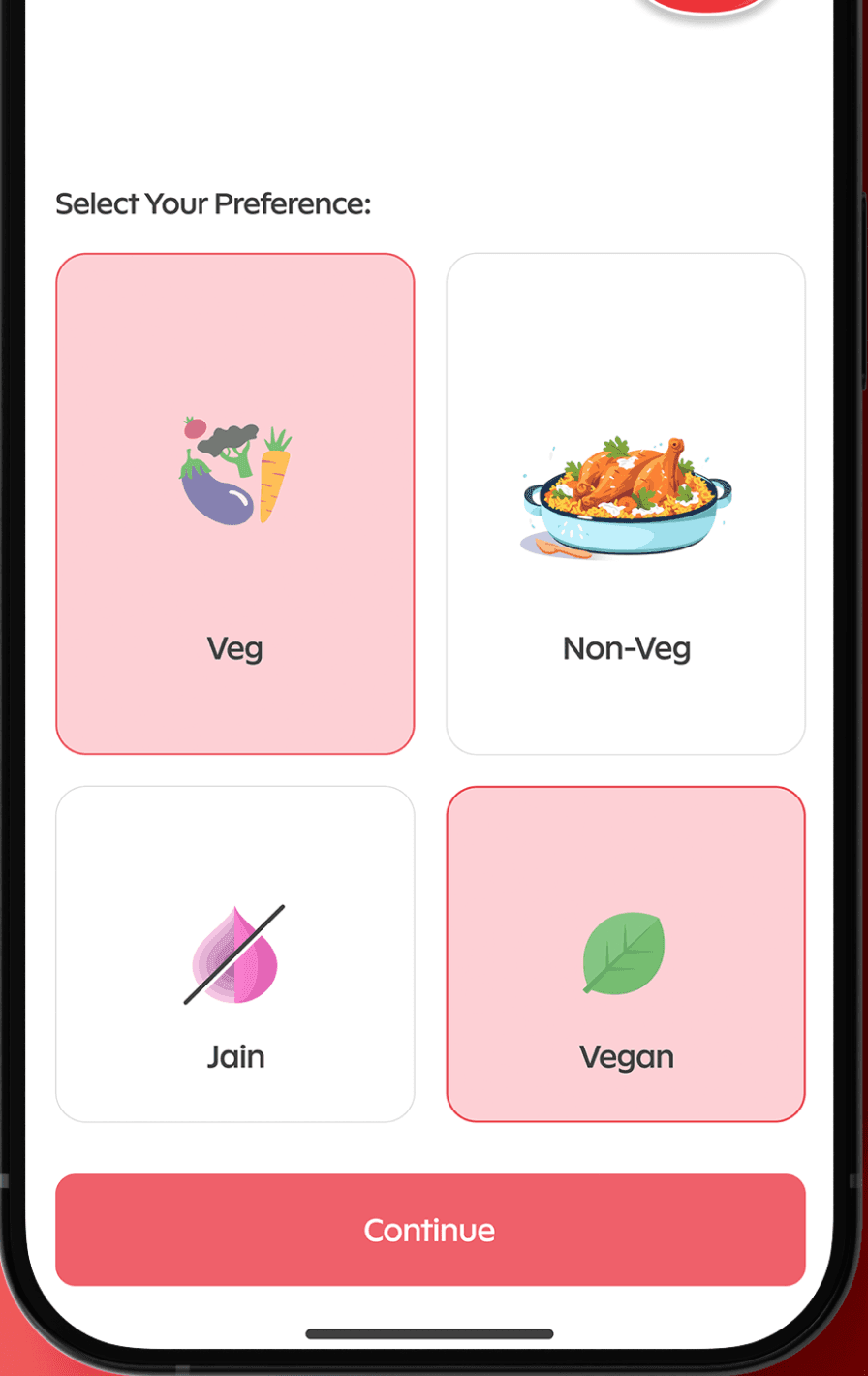
Users can choose their dietary preference such as veg, non-veg, vegan, or Jain before entering Swipe Mode. This acts as a soft constraint, ensuring all surfaced dishes align with personal or cultural food choices

Users can choose their dietary preference such as veg, non-veg, vegan, or Jain before entering Swipe Mode. This acts as a soft constraint, ensuring all surfaced dishes align with personal or cultural food choices

Users explore food one dish at a time using simple swipe gestures, reducing cognitive load and encouraging instinctive decisions instead of comparison.

Swipe-Based Dish Discovery.

Users explore food one dish at a time using simple swipe gestures, reducing cognitive load and encouraging instinctive decisions instead of comparison.

Swipe-Based Dish Discovery.

cherry blossom tree
a japanese style building with a japanese roof and trees around it
Mt. Fuji, Japan
a person holding a small bowl of food

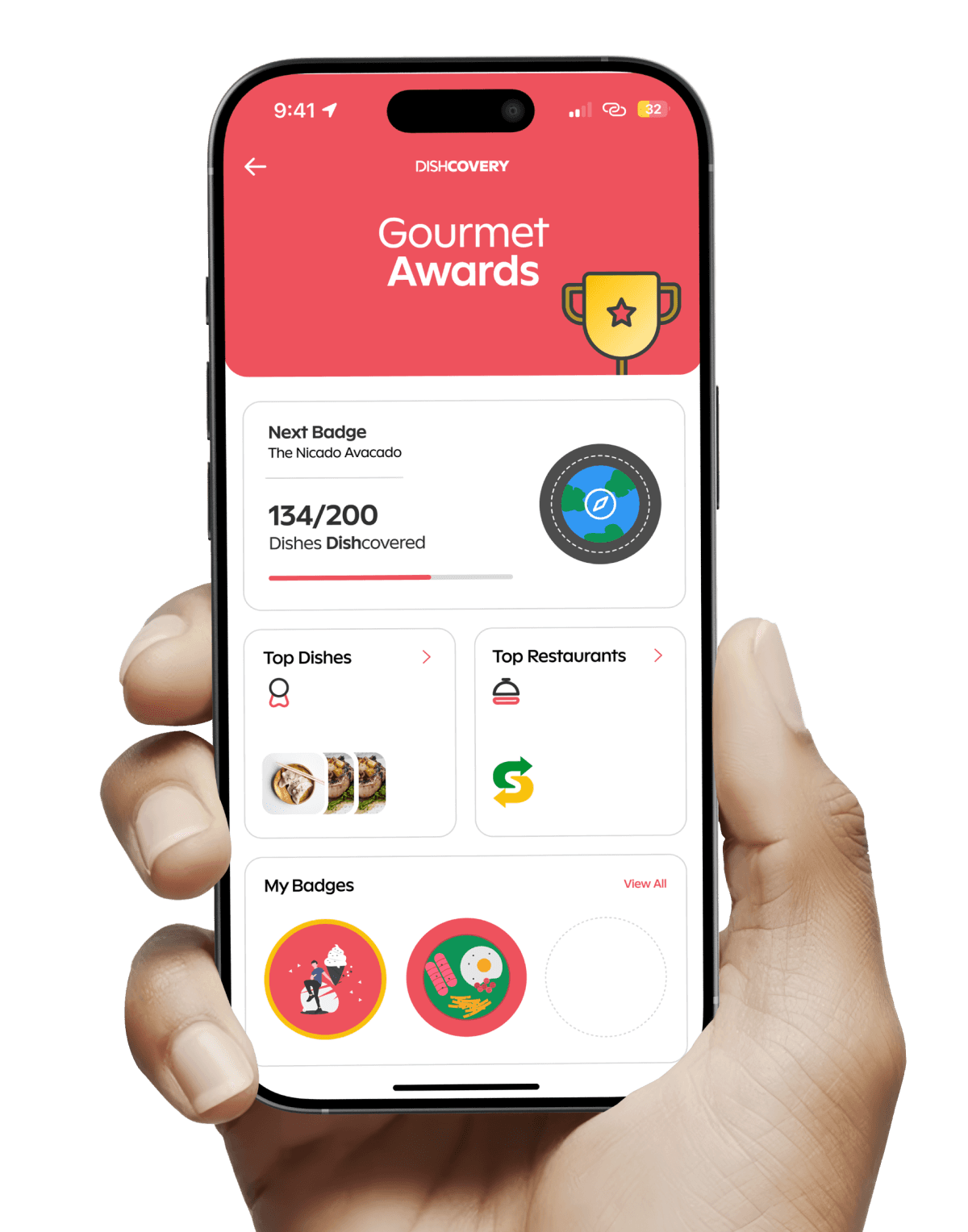
Gourmet Awards.

Gourmet Awards celebrate small user milestones through playful, shareable summaries of their food habits, turning ordering stats into lighthearted digital achievements.

cherry blossom tree
a japanese style building with a japanese roof and trees around it
Mt. Fuji, Japan
a person holding a small bowl of food

Gourmet Awards.

Gourmet Awards celebrate small user milestones through playful, shareable summaries of their food habits, turning ordering stats into lighthearted digital achievements.

Users explore food one dish at a time using simple swipe gestures, reducing cognitive load and encouraging instinctive decisions instead of comparison.

Swipe-Based Dish Discovery.

Users explore food one dish at a time using simple swipe gestures, reducing cognitive load and encouraging instinctive decisions instead of comparison.

Swipe-Based Dish Discovery.

cherry blossom tree
a japanese style building with a japanese roof and trees around it
Mt. Fuji, Japan
a person holding a small bowl of food

Gourmet Awards.

Gourmet Awards celebrate small user milestones through playful, shareable summaries of their food habits, turning ordering stats into lighthearted digital achievements.

cherry blossom tree
a japanese style building with a japanese roof and trees around it
Mt. Fuji, Japan
a person holding a small bowl of food

Gourmet Awards.

Gourmet Awards celebrate small user milestones through playful, shareable summaries of their food habits, turning ordering stats into lighthearted digital achievements.

OUTCOME

OUTCOME

Final UI Screens.

Final UI Screens.

The final UI screens translate the concept into a practical, end-to-end experience within Zomato’s existing design system. The focus is not on visual reinvention, but on restructuring how choices are presented to reduce decision fatigue. Each screen is designed to move the user forward with minimal effort, keeping interactions familiar while introducing a new way to discover food.

The final UI screens translate the concept into a practical, end-to-end experience within Zomato’s existing design system. The focus is not on visual reinvention, but on restructuring how choices are presented to reduce decision fatigue. Each screen is designed to move the user forward with minimal effort, keeping interactions familiar while introducing a new way to discover food.

the new screens!

the new screens!

Entry Point.

Entry Point.

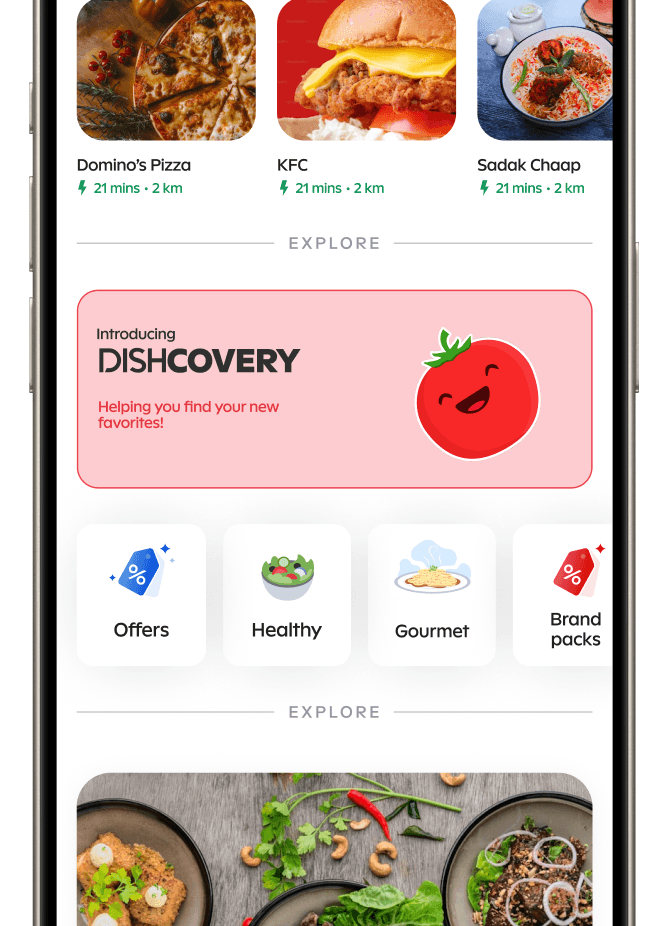
Dishcovery is an in app feature that helps user to find new dishes based on their ordering history ignoring all the scrolling and wasting time.

Dishcovery is an in app feature that helps user to find new dishes based on their ordering history ignoring all the scrolling and wasting time.

Dishcovery is an in app feature that helps user to find new dishes based on their ordering history ignoring all the scrolling and wasting time.

Personalize Experience.

This screen allows you to personalize your experience and show you the dishes according to your diet.

This screen allows you to personalize your experience and show you the dishes according to your diet.

Gourmet Awards.

This screen highlights your exploration achievements and earned medals. You can also view your favorite dishes and the restaurants.

This screen highlights your exploration achievements and earned medals. You can also view your favorite dishes and the restaurants.

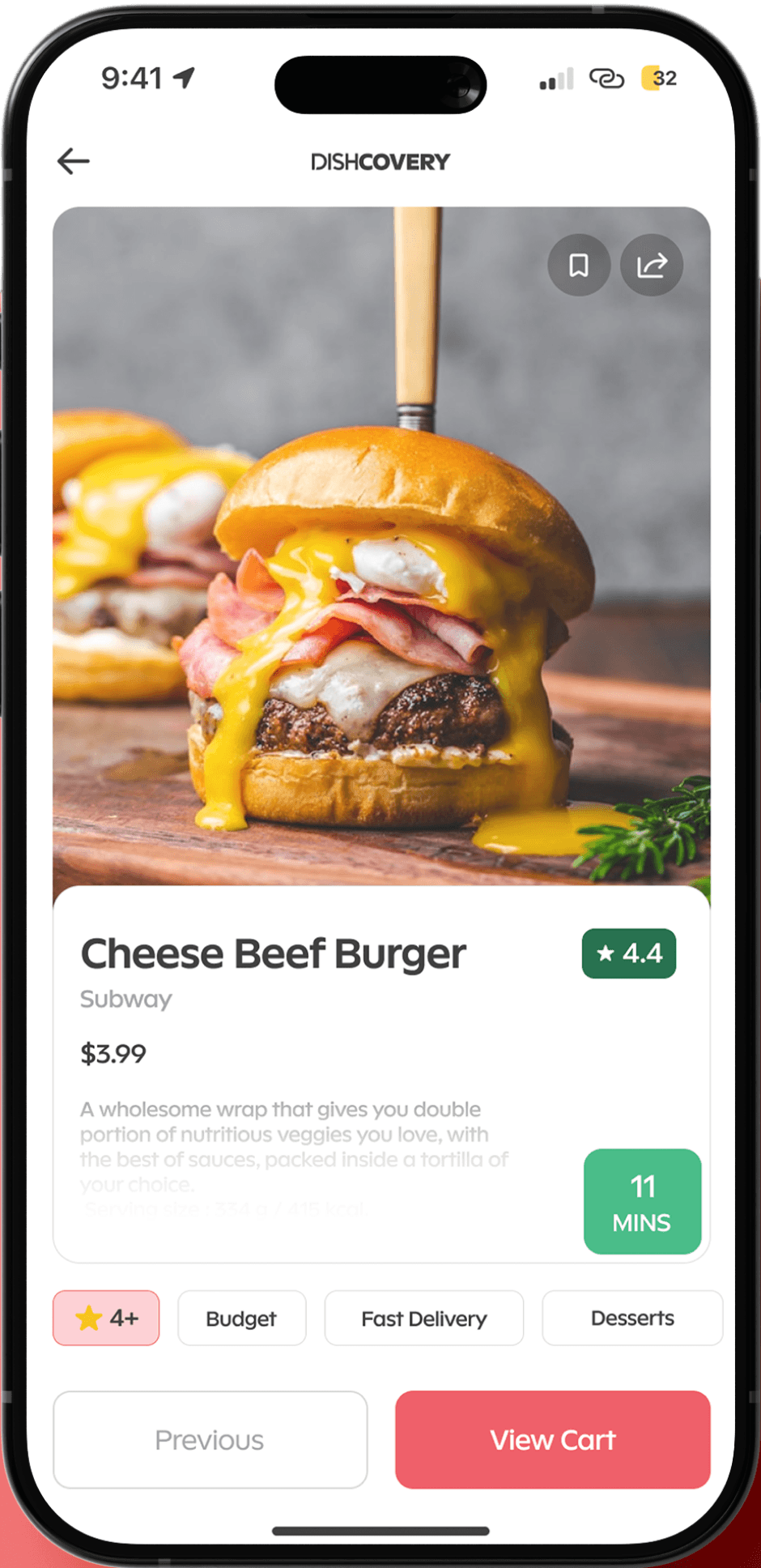
Swipe Screen.

Swipe Screen.

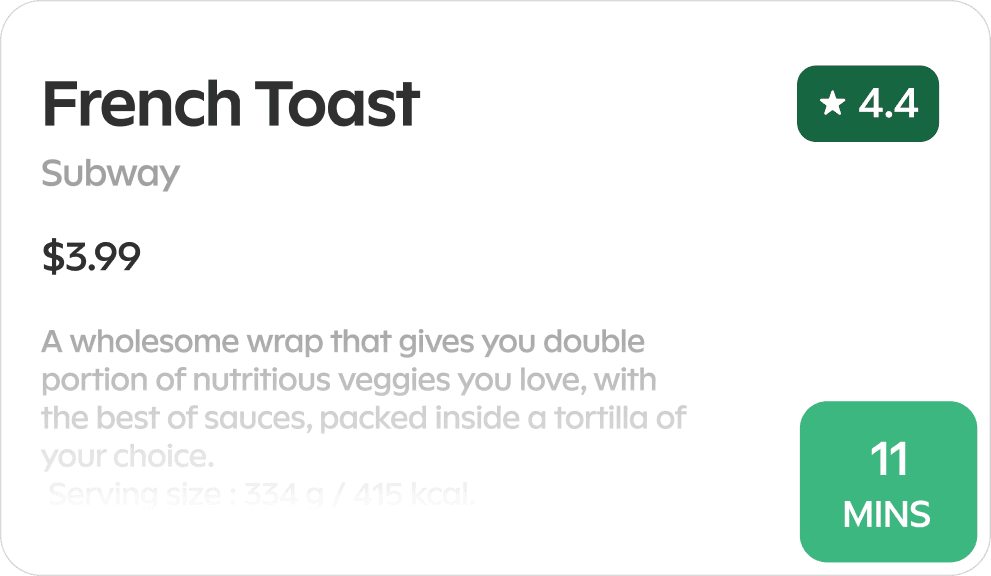
The main screen of the feature design. This screen is a overview of the dish that the user is looking for. Designed keeping in mind what the user might be looking for based on the interviews.

The main screen of the feature design. This screen is a overview of the dish that the user is looking for. Designed keeping in mind what the user might be looking for based on the interviews.

The main screen of the feature design. This screen is a overview of the dish that the user is looking for. Designed keeping in mind what the user might be looking for based on the interviews.

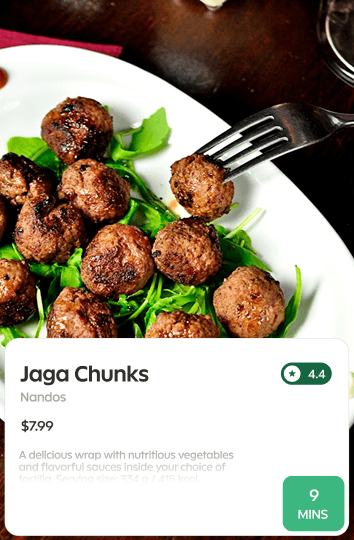
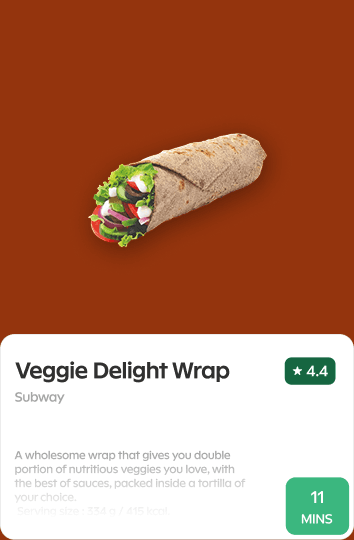
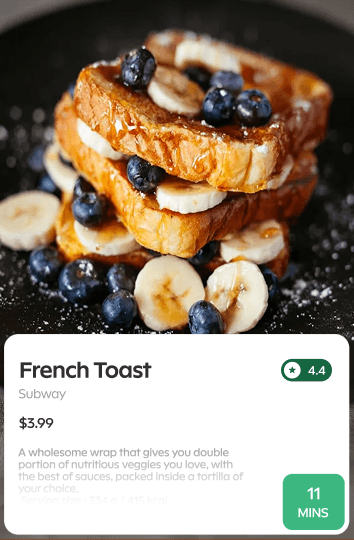
The card has all the information about the dish. The delivery time, ingredients, restaurant details, reviews, and price.

The card has all the information about the dish. The delivery time, ingredients, restaurant details, reviews, and price.

Extra filter to help you narrow down your dishes even more! Fast Delivery for your cravings! (or office hours). Budget friendly dishes for students

Extra filter to help you narrow down your dishes even more! Fast Delivery for your cravings! (or office hours). Budget friendly dishes for students

CONCLUSION

CONCLUSION

My Learnings.

My Learnings.

This project helped me better understand how user psychology influences decision-making, and how subtle interaction patterns can guide behavior without relying on heavy visuals or complex features.

This project helped me better understand how user psychology influences decision-making, and how subtle interaction patterns can guide behavior without relying on heavy visuals or complex features.

Using an existing system enhances thinking.

Using an existing system enhances thinking.

Using an existing system enhances thinking.

Working within Zomato’s visual language allowed me to prioritize structure and flow over novelty. It highlighted that true innovation often stems from rethinking existing patterns rather than creating new aesthetics.

Working within Zomato’s visual language allowed me to prioritize structure and flow over novelty. It highlighted that true innovation often stems from rethinking existing patterns rather than creating new aesthetics.

Working within Zomato’s visual language allowed me to prioritize structure and flow over novelty. It highlighted that true innovation often stems from rethinking existing patterns rather than creating new aesthetics.

Designing for decision-making, not just usability

Designing for decision-making, not just usability

Designing for decision-making, not just usability

This project showed me that usability isn't enough when users face emotional decisions. A usable interface can still fail if it adds cognitive load. I focused on designing flows that minimize mental effort and support user intent, especially during craving-driven moments.

This project showed me that usability isn't enough when users face emotional decisions. A usable interface can still fail if it adds cognitive load. I focused on designing flows that minimize mental effort and support user intent, especially during craving-driven moments.

This project showed me that usability isn't enough when users face emotional decisions. A usable interface can still fail if it adds cognitive load. I focused on designing flows that minimize mental effort and support user intent, especially during craving-driven moments.

Awareness of gamification as a dark pattern

Awareness of gamification as a dark pattern

Awareness of gamification as a dark pattern

This project made me aware of how gamified interactions can be used as dark patterns to increase engagement beyond user intent.

This project made me aware of how gamified interactions can be used as dark patterns to increase engagement beyond user intent.

This project made me aware of how gamified interactions can be used as dark patterns to increase engagement beyond user intent.

09:19:38

TABLET VIEW IS STILL UNDER DEVELOPMENT.